You can fine-tune almost any White Balance setting on your Nikon D3100, D5100, or D7000 (the exceptions being custom presets that you create through the PRE option). Make the adjustment as spelled out in these steps:

Dec 21, 2017 Nikon Learn & Explore - Auto AF Fine Tune (with French subtitles) - Duration: 8:06. Nikon Canada 10,195 views. Aperture & Depth of Field made EASY - Photography Course 5/10 - Duration: 17:22.
Display the Shooting menu, highlight White Balance, and press OK.
Dubstep vst fl studio download. Highlight the White Balance setting you want to adjust and press the Multi Selector right.
You’re taken to a screen where you can do your fine-tuning.
If you select Fluorescent, you first go to a screen where you select a specific type of bulb. After you highlight your choice, press the Multi Selector right again to get to the fine-tuning screen.
Fine-tune the setting by using the Multi Selector to move the white balance shift marker in the color grid.
The grid is set up around two color pairs: Green and Magenta, represented by G and M; and Blue and Amber, represented by B and A. By pressing the Multi Selector, you can move the adjustment marker around the grid.
As you move the marker, the A-B and G-M boxes on the right side of the screen show you the current amount of color shift. A value of 0 indicates the default amount of color compensation applied by the selected White Balance setting.
Press OK to complete the adjustment. Free studio software with auto tune.
After you adjust a White Balance setting on your Nikon DSLR, an asterisk appears next to the icon representing the setting on the Shooting menu (and possibly other places, depending on your camera model: D3100, D5100, or D7000).
Through the AF-area mode available to you on your Nikon D3100, you tell the camera’s autofocusing system what part of the frame contains your subject so that it can set the focusing distance correctly.
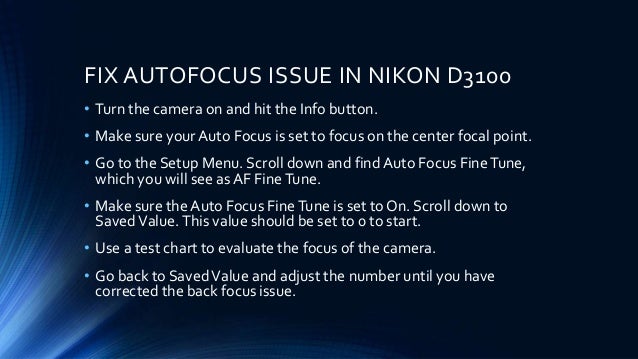
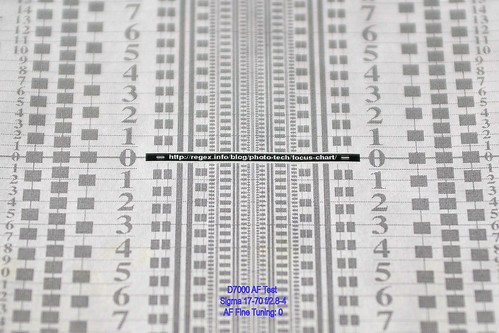
D3100 Auto Fine Tuner
The Live View AF-area mode options are different than the ones available for viewfinder photography. For Live View photography and video recording, you can choose from the following settings:
Face Priority: Designed for portrait shooting, this mode attempts to hunt down and lock focus on faces when you press the shutter button halfway. This setting is the only one available if you use the Auto or Auto Flash Off exposure modes, and is the default setting in Portrait, Child, Landscape, or Night Portrait mode.
Wide Area: In this mode, you use the Multi Selector to move a little rectangular focusing frame around the screen to specify your desired focusing spot. When you press the shutter button halfway, the camera locks focus on objects within the focusing frame.
Normal Area: This mode works the same way as Wide Area autofocusing but uses a smaller focusing frame. The idea is to enable you to base focus on a very specific area. It’s the default mode for pictures you take in the Close Up exposure mode.
SubjectTracking: This mode tracks a subject as it moves through the frame and is designed for focusing on a moving subject. But note that subject tracking isn’t always as successful as you might hope. When the conditions are right, it works well, but otherwise, the Wide Area setting gives you a better chance of keeping a moving subject in focus.
Again, Auto and Auto Flash Off modes don’t permit you to change the AF-area setting. In other modes, use either of these two techniques:
D3100 Auto Fine Tunes
Quick Settings display: Press the Info Edit button to shift to Quick Settings mode. Then highlight the AF-area mode icon. Press OK to access a screen containing the four focusing options. Highlight your choice, press OK, and then press the Info Edit button again to exit the Quick Settings screen.
Shooting menu: As an alternative, you can change the setting via the Shooting menu. Select AF-Area Mode from the menu and then press OK. Then choose Live View to display the list of options.
Any time you press the Menu button, the camera exits Live View mode. So after you change the menu setting, you must flip the Live View switch to get back to the Live View display.